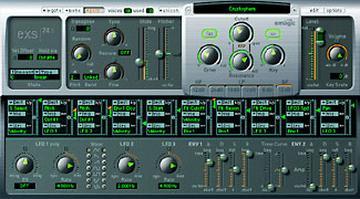
EXS 24 Logic Sampler Users Group group photo

Yahoo Groups archive

EXS 24 Logic Sampler Users Group

Index last updated: 2026-04-28 23:25 UTC

Thread

Sampled Piano CPU Load Question

Sampled Piano CPU Load Question

2006-02-07 by Greg C

I've posted this question on a few other forums that I'm usually on,
and I haven't been able to get an answer...

I've got a semi-technical question regarding the CPU load generated
from playing a sampled piano vs. other sampled instruments.

As anyone who's ever played a software piano knows, if you play too
many sustained notes for too long with too low of a buffer setting
you're going to run out of CPU headroom and get crackles & pops.

Through my experience playing multiple instruments through my laptop
I've noticed that my piano sample libraries will deplete my CPU
headroom TREMENDOUSLY faster than my Scarbee electric pianos - even
though the pianos are running flat & dry and the EPs are running
through AMP models, reverb, tremelo, & EQ and other effects.

Both the pianos and EPs are being played using the EXSP24 out of Logic
Express 7.1.

My thinking is that since I'm playing the Scarbee libraries with all
the keys sampled at 12-14 different velocities the computer just has
to stream the audio samples, but with the pianos using 3-4 velocities
of every 3rd note there is alot more pitch shifting and filtering
going on. Is my thinking correct, is the filtering & pitch shifting
that the EXS is doing causing that much headroom bite over the Scarbee
libraries? Is there something else going on?

This leads me to my other question... If my assumption is correct,
does this mean that I'll have more CPU headroom if I go to a larger
piano sample library? My system has more RAM space to spare than CPU
headroom, and I'd greatly aborb a longer load and more RAM usage in
exchange for more CPU headroom and a lower buffer setting. Is this the
reality of the situation or is my logic flawed?

Here are my system specifics:
Apple Powerbook G4 17" (1.5GHZ / 1.5GB RAM)
Logic Express 7.1
Buffer Size - 128 for Scarbee, 256 for Pianos

Here are the core sample libraries I use live:
Scarbee RSP73 (12V Lite)
Scarbee WEP (14V Lite)
Garageband Grand Piano
Logic Yamaha Grand Piano
SampleTekk Rain Piano

Re: Sampled Piano CPU Load Question

2006-02-08 by Jeremy Martin

You might take a look at your disk I/O when playing the two libraries
- I would guess the higher CPU load is caused by not being able to fit
all the samples into RAM, and the computer struggling to swap lots of
data in and out constantly. You can compare by watching Activity
Monitor / Disk Activity.

Re: [EXS] Re: Sampled Piano CPU Load Question

2006-02-08 by james page

--- Jeremy Martin <jeremy@...> wrote:

> You might take a look at your disk I/O when playing
> the two libraries
> - I would guess the higher CPU load is caused by not
> being able to fit
> all the samples into RAM, and the computer
> struggling to swap lots of
> data in and out constantly. You can compare by
> watching Activity
> Monitor / Disk Activity.

The manual say to turn off Virtual memory if you don't
need it. How does one determine that? Also what is the
disadvantage to leaving it turned on?  Doesn't it only
come into play when you run out of RAM capacity? 

Thanks, JP

G5 2x2 
4.5g RAM

Re: [EXS] Re: Sampled Piano CPU Load Question

2006-02-08 by Sean McCoy

At 12:37 PM 02/08/2006, james page wrote:


>--- Jeremy Martin <jeremy@...> wrote:
>
> > You might take a look at your disk I/O when playing
> > the two libraries
> > - I would guess the higher CPU load is caused by not
> > being able to fit
> > all the samples into RAM, and the computer
> > struggling to swap lots of
> > data in and out constantly. You can compare by
> > watching Activity
> > Monitor / Disk Activity.
>
>The manual say to turn off Virtual memory if you don't
>need it. How does one determine that? Also what is the
>disadvantage to leaving it turned on?  Doesn't it only
>come into play when you run out of RAM capacity?

Yes. And this will be very early if you're using any of the 
now-common mondo sample sets---no matter how much RAM you have 
installed. Sample streaming from hard disk is now the norm, and works 
well as long as you have reasonably fast hard drives.

Re: [EXS] Re: Sampled Piano CPU Load Question

2006-02-08 by james page

> At 12:37 PM 02/08/2006, james page wrote:

> >The manual say to turn off Virtual memory if you
> don't
> >need it. How does one determine that? Also what is
> the
> >disadvantage to leaving it turned on?  Doesn't it
> only
> >come into play when you run out of RAM capacity?


--- Sean McCoy <osr@...> wrote:
> 
> Yes. And this will be very early if you're using any
> of the 
> now-common mondo sample sets---no matter how much
> RAM you have 
> installed. Sample streaming from hard disk is now
> the norm, and works 
> well as long as you have reasonably fast hard
> drives.

So in other words, For most users, Virtual Memory
should always be on?
I thought i remembered Michiel Post recommending it be
turned off for his pianos if the user had 3 or more
gigs RAM. Maybe he was assuming that the piano would
be the only RAM hog in use.
JP

[EXS] Re: Sampled Piano CPU Load Question

2006-02-08 by mandcmiller

--- In exs-users@yahoogroups.com, Sean McCoy <osr@...> wrote:
>
> At 12:37 PM 02/08/2006, james page wrote:
> 
> 
> >--- Jeremy Martin <jeremy@...> wrote:
> >
> > > You might take a look at your disk I/O when playing
> > > the two libraries
> > > - I would guess the higher CPU load is caused by not
> > > being able to fit
> > > all the samples into RAM, and the computer
> > > struggling to swap lots of
> > > data in and out constantly. You can compare by
> > > watching Activity
> > > Monitor / Disk Activity.
> >
> >The manual say to turn off Virtual memory if you don't
> >need it. How does one determine that? Also what is the
> >disadvantage to leaving it turned on?  Doesn't it only
> >come into play when you run out of RAM capacity?
> 
> Yes. And this will be very early if you're using any of the 
> now-common mondo sample sets---no matter how much RAM you have 
> installed. Sample streaming from hard disk is now the norm, and works 
> well as long as you have reasonably fast hard drives.
>

I just did a test where I created a new 64 voice instrument w/ a looped single cycle 
waveform. I created a sequence in the matrix editor that played 61 simultaneous notes (5 
octaves) for 8 bars. The cpu took quite a hit. I then took a single note (C6) played for the 8 
bars and bounced that down to disk. I loaded that (unlooped) into a new 64 voice 
instrument and played back the same 61 note sequence. The cpu hit was a lot lower. I 
purposely bounced the higher note (C6) so I would be able to play back the whole 
sequence over the 8 bars. As I suspected, the computer seems to work harder looping a 
file vs streaming it from disk. So, all things being equal (fast computer, plenty of RAM, fast 
hard drive), it's probably better not to loop.

-Matt

Move to quarantaine

This moves the raw source file on disk only. The archive index is not changed automatically, so you still need to run a manual refresh afterward.