> > There is no unison mode in Pentagon/Z3ta+.  I have been lobbying for
this
> > and it is a possible future addition.  What they do have is 'Multi'
> > oscillator algorithms which model 4 waveforms detuned per osc.

> Rene has told me directly that the algorithm he uses gives 8 "voices" for
the
> price (in CPU terms) of 1.5.

What he is telling you is that he can create 8 waves for the cpu hit of 1.5
.    He would do that using a 'Multi' oscillator algorythm, each one capable
of outputting 8 waves per single note on message.

(Side note :- Before in my previous post, when I said it was 4 waves per
'Multi' I was thinking of the Z3TA using one 'Multi' Oscillator with the
output bus balance control set to bus 1 only.  If it had been partially
routed to bus 2 as well then there would have been 8 waves sounding, as the
Z3TA 'Multi' algorythm sends 4 waves to bus 1 and 4 to bus 2.   Pentagon's
'Multi' always sends 8 waves to filters f1 or f2.  There is no way to split
it and get 4 in each.)

So this Multi algorythm is like one oscillator acting as 8 virtual
oscillators all producing the same wave shape, which could be a saw or
square or any that the normal oscillator algorythm could produce.   But it
has to be a simple wave,  there are no options for syncing the oscillator,
FM, PM or ring modulation with  other oscillators.

There is the option of the having the Multi's 8 virtual oscillator waves key
synced or free running.   This makes an inportant difference to the sound.
Key syncing means that at the instant of note on, all the 8 virtual waves
are in phase and the sound is thin, as they drift apart the sound gets
fatter.   The rate at which they drift/fatten the sound is dependant on how
out of detuned they all are.  I much prefer the free-running mode in
Pentagon/Z3TA.   But whatever mode is used it is still only oscillators
detuned.   Quoting my original post below:

> >   This is
> > different to true unison mode which should be whole voices stacked and
> > detuned.  The beauty of true unison is that it can be applied to any
existing
> > patch, for example a synced osc patch, and the synced sound would get
fatter
> > depending on no. of voices and detune amount.   With the Pentagon/Z3ta+
> > 'multi' method the synced oscillator would be replaced with the multi
osc
> > giving a totally different sound.

To be precise a non synced-osc sound.   Where as true unison would stack and
detune multiple synced oscillators, a huge difference. The Pentagon manual
only claims it sounds *like* unison, the Z3TA manual makes no mention of
unison.

All vintage analogue synths that have unison mode stack all available
voices.  There was perhaps no detune control because all the voices were out
of tune slightly anyway, it was unavoidable with analogue synths.

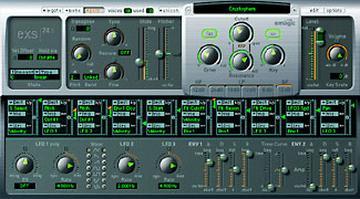
Emagic claim to be using unison on the EXSII by stacking whole voices.  If
they are, they screwed up its potential by key syncing the voices phases
presisely at note on.      This gives the same sound, described above, as in
the 'Multi' oscillator algorythm, in key sync mode, as on RGC Audio's
Pentagon and Z3TA+ synths.   A thin sound gradually getting fatter.   If
they had staggered the voice starts slightly, each by fraction of a wave
length, it would have given the impression of free running oscillators and
hence constant fatness.

> What I was talking about was using the Random Detune while in unison
mode --
> the random detune seems to affect the added voices so that you get a much
> larger  spread of tunings and a deep flanging effect on bass tones.

The other way they have screwed the unison is by using random amounts of
detune.  Where the EXSII pdf file says that the unison voices are
'symetrically' detuned, that just means that the voices have equal detune
amounts between them.  Those amounts still fluctuate with the random control
signal.
 In other words as you play notes, some are fat and juicy, others are thin
and puny.  Not what you want in a big impressive techno riff,  it sounds
like bum notes.   They should at least  have given the ability to detune by
a constant amount in cents.  If they were really smart they would also have
provided the option of detuning as a frequency offset in Hertz.   This gives
a constant beat frequency across the keyboard.   I can detune the
oscillators in my Z1 using this method, but the unison voices detune by
cents, so I have yet to hear the offset method but know it would sound good.


> >  I have a Korg Z1 and it has a great
> > unison mode that properly detunes whole voices with no
phase-synchronised
> > note starts.

> I would be interested to hear what that sounds like. I would guess that
synth
> generates its voices in dedicated hardware so CPU conservation is less of
an
> issue.

It sounds like detuning multiple oscillators but the can be doing sync, fm,
pm ,ring mod whatever.

regards,  Hector.