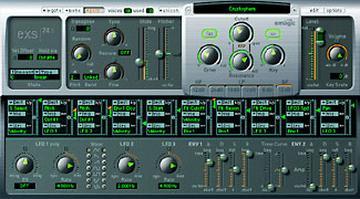
EXS 24 Logic Sampler Users Group group photo

Yahoo Groups archive

EXS 24 Logic Sampler Users Group

Index last updated: 2026-04-28 23:25 UTC

Thread

Scarbee R.S.P. '73 is shipping!

Scarbee R.S.P. '73 is shipping!

2002-12-16 by Thomas Hansen Skarbye <thomas@scarbee.co

Scarbee is proud to announce the immediate release of the Scarbee 
R.S.P.' 73, the most comprehensively sampled Rhodes piano on earth. 
The depth and sophistication of this sampling project has allowed us 
to finally capture the elusive 'soul' of the Rhodes piano.

The R.S.P.'73 consists of a collection of truly authentic `deeply 
sampled' renderings of the classic Fender Rhodes Stage Piano MK I -
 '73, captured in high definition 24 bit quality. Ingenious Danish 
programming has resulted in both the 24 bit Emagic EXS24 mkII and 24 
bit Steinberg Halion editions of the library being included in the 
same 4 CD set, with the added bonus that registered users will 
shortly be able to download the 24 bit Native Instruments Kontakt 
version at no extra cost. The same programming system allows 
purchasers of the 2 CD set 16 bit Gigastudio edition to download 
small files which will allow installation of both the 16 bit Emagic 
EXS24 mk II and Steinberg Halion editions at no extra charge. This 
new delivery system should prove to be a major boon to both users 
who need to switch sample platforms from time to time, and dealers - 
who will be able to supply the library for any of several popular 
samplers simply by stocking two multi platform editions.

The Scarbee R.S.P.' 73 was recorded at 24 bit resolution through a 
Mindprint En-Voice preamp (without any use of EQ, tube saturation or 
compression), and then digitally transferred to a Nuendo AudioLink 
96 audio card. The piano sound was captured directly from the harp, 
bypassing the passive tone control on the front panel, in order to 
capture the full frequency range of the instrument and minimise 
unwanted noise. All sample editing – including noise reduction and 
normalizing was also done at 24 bit resolution.

The Giga edition includes two versions of the Rhodes:
The "Direct" version, was recorded directly from the Rhodes harp, 
bypassing the passive tone controls.
The "Classic" version simulates the output from the front panel 
socket of the Rhodes, with the "bass boost" knob set at 5 (the 
middle position).
Each Giga version utilises 1752 samples and weighs in at 1.5 
gigabytes.
Registered Giga owners can download the 16 bit EXS24 MK II and 16 
Halion version at no cost.

The 24 bit native EXS24 mk II and the 24 bit native HALion editions 
are not conversions. They have been programmed `from scratch' using 
the "Direct from harp" sound. Programming this way allows us to 
utilise every facility available on the native sampler, rather than 
create something which might have taken mere minutes to port, but 
which was only `pretty close' to the original version because of 
inaccuracy in the porting software. In fact, critical comparison of 
the three versions has confirmed that they have identical timbre and 
response. The "Classic" sound can easily be created by using the 
internal EQ of your favourite sequencer program. Accurate presets 
for Cubase and Logic are included with the library.
Each 24 bit version utilises 1752 samples and requires 2.25 
gigabytes of disk space (shared).
Registered 24 bit EXS24 II and Halion users will shortly be able to 
download the 24 bit Native Instruments Kontakt version at no cost.

How much detail is there in the instrument?

To start with, all samples are full length and unlooped. Each of the 
73 keys of the Rhodes was sampled at 12 different velocities – 
ranging from 0 to -26 dB - but this is only half the story. In order 
to capture that magical feel of really `playing' a Rhodes, we also 
recorded `release' samples for each of the 12 velocities, at the 
exact same level as the corresponding 12 sustain samples. The 
release tone - a sound created when a damper bounces against the 
tine as a key is released, is an intrinsic element of what musicians 
recognise as the original `Rhodes Sound'.

To accommodate systems with RAM limitations, several `Lite' versions 
of the piano are included. Lite versions contain the samples of the 
white keys, which are stretched up or down a semitone to cover 
adjacent black keys. Lite versions come in 12, 8 and 4 velocity 
layer flavours. 

For that duller `old school' sound, a special Hi-cut version of each 
program is also included. 

In response to a number of requests, all programs are available in 
both Equal and Stretch tunings.

HALion release trigger breakthrough…

In order to overcome the current HAlion release trigger obstacle, we 
created 876 special release samples for the HALion version of the 
R.S.P '73. The result is that the sound, feel and action of all 
three editions (Giga, EXS24 and HALion) is identical!

Preparing the piano….

In order to guarantee that the sampled Rhodes was as close to, or 
better than, it's original 1976 condition as possible, an exhaustive 
process of refurbishment was undertaken prior to the recording 
process.

All rubber hammer tips and damper felts were replaced. Hammers, keys 
and harp were modified for optimal response/action. Rubber grommets 
on the tone bars were replaced to improve sustain. New tines were 
carefully selected for ideal timbre and sustain. Tonebars, tines and 
pickups were also carefully adjusted to provide a perfectly balanced 
sound – ranging from warm and mellow to but bright and barking!

During the whole programming phase we even used a proprietary system 
of sampling in order to ensure that the sound, action and feel of 
the original was mirrored and maintained. We went to this kind of 
trouble because a key element in recreating the experience of 
playing a real Rhodes is accurately capturing the response dynamics 
of a real Rhodes. As a result of this effort, the action and feel of 
the Scarbee R.S.P.' 73 exactly duplicates that of a well `hot 
rodded' Rhodes. 

Why is the `feel' important? 

If you are a composer or piano player, you will no doubt be able to 
answer this question for yourself. The Rhodes piano is one of a 
select few instruments which can honestly claim to be a writer's 
primary compositional workhorse. Not just a tool for committing 
already firm ideas to a recording medium, but an inspirational tool –
 an instrument which works in a synergistic way with the composer to 
generate fresh new musical ideas, simply through the act of sitting 
down with it and playing freely. We believe that this inspirational 
quality is largely the result of a combination of the basic timbral 
range of the original Rhodes piano and its very organic dynamic 
response. We dare to say that the Scarbee R.S.P. `73 has, for the 
first time, captured that same tone and feel – the `soul' of the 
Rhodes piano.. The R.S.P.'73 is an instrument you really look 
forward to sitting down and just playing.*

Why sampling in preference to a physical modelling approach?

Physical modelling is a great synthesis option which allows us to 
break down and explore the nature of a sound, but it relies very 
heavily on the software engineer's ability to fathom the unique 
elements which combine to create that sound, to analyse and measure 
them, to write code which can accurately recreate them, and to find 
a hardware platform capable of delivering enough DSP muscle to 
realise the software in high resolution. This process requires that 
many subtle, and some not so subtle, choices be made by the 
engineering team. As a result, the end product is often the 
combination of a few individuals' opinions, a programming team's 
expertise in coding, and the processing abilities of the host 
platforms available at the time the software is designed. It's a bit 
like computer animated characters in movies. Although they are 
generated by extremely sophisticated software and hardware, and can, 
say, morph from a person to a grapefruit and back in seconds, 
they're still just 'pretty close' when it comes to delivering a 
credible alternative to a real actor. The Scarbee R.S.P. '73 is more 
like film of a human actor in comparison. Perhaps not able to morph 
into a grapefruit, but totally believable in its main role as 
a 'real actor'.

Unlike a modelled instrument, the Scarbee R.S.P. `73 is not a 
software engineer's approximation of the elements which combine to 
create a Rhodes-like sound. The Scarbee R.S.P. `73 is a high 
definition mirror image of an actual Rhodes piano. 

* And now, some comments from early beta testers who played the 
R.S.P.'73, and others who have heard initial demos:

"Scarbee's Rhodes has that soul and lots of it! This is the real 
deal...the first Rhodes I've been completely content with."

"With the Scarbee RSP there is just no way that you can play it that 
will not still sound like a Rhodes. And that -ladies and gentlemen- 
is the ultimate torture test of a sampled keyboard instrument."

"It's a fun instrument. The guys on the beta group have had a blast 
with this library, as you can tell from the demos."

"When I first started beta-testing Thomas' Rhodes, I immediately 
knew I wouldn't play another Rhodes if I ever had a choice. Sure you 
don't get the nostalgia trip of sitting down at a real Fender, but 
then you also don't get the knackered tines, sticking keys, noisy 
preamp etc. No toys or bull****, just the perfect Rhodes."

"This Rhodes PLAYS exactly like a Rhodes. You play soft and cruisy, 
and that's what you get. Stab at the keyboard, poke it, smack it, 
and a good Rhodes will bark back aggressively. The RSP 73 does all 
this as well."

"I had never really thought about the bounce back of the dampers 
when you release a key on a real Rhodes, and in fact I never 
realised that they were a missing factor in any sampled Rhodes I've 
used - until Thomas sent me the first beta. I couldn't believe how 
much more 'solid' this sampled version felt. It feels great to play."

"If you loved your Rhodes and miss being able to integrate THAT 
sound into your midi compositions - I guarantee the R.S.P.'73 will 
make you as happy as a pig in mud!"

"The RSP just has a responsiveness which, no matter how much I 
tweaked the EVP, I could never quite replicate."

"I can assure you that every little noise the RSP makes, - so does a 
real Rhodes, and vice versa. And yes, I am in a way affiliated with 
Scarbee: he has borrowed my Rhodes to sample! This is also the fact 
that enables me to conclude: Not only has Thomas captured the sound 
of my Rhodes to a level of perfection that very few people on earth 
would ever have patience to do even if they had the technical 
abilities but he has also captured the hard-to-explain "feeling" of 
the Rhodes. I can only say, when I play the RSP, I am playing the 
real thing. Honestly: The difference is ONLY in the acoustics of my 
mother keyboard versus my Rhodes: The "klonk" of the keys is 
different."

"The RSP73 IS as some others have already noted a carbon copy of a 
Mark I in all of its grit and glory."

"I can't say anything more than anyone else here, but I have to join 
the chorus here in saying WOW!"

For more information, prices and demoes, visit our web site at 
www.scarbee.com

regards

--------------------
Thomas Hansen Skarbye
Sample Library Producer, SCARBEE
www.scarbee.com

Scarbee R.S.P. '73 is shipping!

2002-12-16 by Thomas Hansen Skarbye <thomas@scarbee.co

Scarbee is proud to announce the immediate release of the Scarbee 
R.S.P.' 73, the most comprehensively sampled Rhodes piano on earth. 
The depth and sophistication of this sampling project has allowed us 
to finally capture the elusive 'soul' of the Rhodes piano.

The R.S.P.'73 consists of a collection of truly authentic `deeply 
sampled' renderings of the classic Fender Rhodes Stage Piano MK I -
 '73, captured in high definition 24 bit quality. Ingenious Danish 
programming has resulted in both the 24 bit Emagic EXS24 mkII and 24 
bit Steinberg Halion editions of the library being included in the 
same 4 CD set, with the added bonus that registered users will 
shortly be able to download the 24 bit Native Instruments Kontakt 
version at no extra cost. The same programming system allows 
purchasers of the 2 CD set 16 bit Gigastudio edition to download 
small files which will allow installation of both the 16 bit Emagic 
EXS24 mk II and Steinberg Halion editions at no extra charge. This 
new delivery system should prove to be a major boon to both users 
who need to switch sample platforms from time to time, and dealers - 
who will be able to supply the library for any of several popular 
samplers simply by stocking two multi platform editions.

The Scarbee R.S.P.' 73 was recorded at 24 bit resolution through a 
Mindprint En-Voice preamp (without any use of EQ, tube saturation or 
compression), and then digitally transferred to a Nuendo AudioLink 
96 audio card. The piano sound was captured directly from the harp, 
bypassing the passive tone control on the front panel, in order to 
capture the full frequency range of the instrument and minimise 
unwanted noise. All sample editing – including noise reduction and 
normalizing was also done at 24 bit resolution.

The Giga edition includes two versions of the Rhodes:
The "Direct" version, was recorded directly from the Rhodes harp, 
bypassing the passive tone controls.
The "Classic" version simulates the output from the front panel 
socket of the Rhodes, with the "bass boost" knob set at 5 (the 
middle position).
Each Giga version utilises 1752 samples and weighs in at 1.5 
gigabytes.
Registered Giga owners can download the 16 bit EXS24 MK II and 16 
Halion version at no cost.

The 24 bit native EXS24 mk II and the 24 bit native HALion editions 
are not conversions. They have been programmed `from scratch' using 
the "Direct from harp" sound. Programming this way allows us to 
utilise every facility available on the native sampler, rather than 
create something which might have taken mere minutes to port, but 
which was only `pretty close' to the original version because of 
inaccuracy in the porting software. In fact, critical comparison of 
the three versions has confirmed that they have identical timbre and 
response. The "Classic" sound can easily be created by using the 
internal EQ of your favourite sequencer program. Accurate presets 
for Cubase and Logic are included with the library.
Each 24 bit version utilises 1752 samples and requires 2.25 
gigabytes of disk space (shared).
Registered 24 bit EXS24 II and Halion users will shortly be able to 
download the 24 bit Native Instruments Kontakt version at no cost.

How much detail is there in the instrument?

To start with, all samples are full length and unlooped. Each of the 
73 keys of the Rhodes was sampled at 12 different velocities – 
ranging from 0 to -26 dB - but this is only half the story. In order 
to capture that magical feel of really `playing' a Rhodes, we also 
recorded `release' samples for each of the 12 velocities, at the 
exact same level as the corresponding 12 sustain samples. The 
release tone - a sound created when a damper bounces against the 
tine as a key is released, is an intrinsic element of what musicians 
recognise as the original `Rhodes Sound'.

To accommodate systems with RAM limitations, several `Lite' versions 
of the piano are included. Lite versions contain the samples of the 
white keys, which are stretched up or down a semitone to cover 
adjacent black keys. Lite versions come in 12, 8 and 4 velocity 
layer flavours. 

For that duller `old school' sound, a special Hi-cut version of each 
program is also included. 

In response to a number of requests, all programs are available in 
both Equal and Stretch tunings.

HALion release trigger breakthrough…

In order to overcome the current HAlion release trigger obstacle, we 
created 876 special release samples for the HALion version of the 
R.S.P '73. The result is that the sound, feel and action of all 
three editions (Giga, EXS24 and HALion) is identical!

Preparing the piano….

In order to guarantee that the sampled Rhodes was as close to, or 
better than, it's original 1976 condition as possible, an exhaustive 
process of refurbishment was undertaken prior to the recording 
process.

All rubber hammer tips and damper felts were replaced. Hammers, keys 
and harp were modified for optimal response/action. Rubber grommets 
on the tone bars were replaced to improve sustain. New tines were 
carefully selected for ideal timbre and sustain. Tonebars, tines and 
pickups were also carefully adjusted to provide a perfectly balanced 
sound – ranging from warm and mellow to but bright and barking!

During the whole programming phase we even used a proprietary system 
of sampling in order to ensure that the sound, action and feel of 
the original was mirrored and maintained. We went to this kind of 
trouble because a key element in recreating the experience of 
playing a real Rhodes is accurately capturing the response dynamics 
of a real Rhodes. As a result of this effort, the action and feel of 
the Scarbee R.S.P.' 73 exactly duplicates that of a well `hot 
rodded' Rhodes. 

Why is the `feel' important? 

If you are a composer or piano player, you will no doubt be able to 
answer this question for yourself. The Rhodes piano is one of a 
select few instruments which can honestly claim to be a writer's 
primary compositional workhorse. Not just a tool for committing 
already firm ideas to a recording medium, but an inspirational tool –
 an instrument which works in a synergistic way with the composer to 
generate fresh new musical ideas, simply through the act of sitting 
down with it and playing freely. We believe that this inspirational 
quality is largely the result of a combination of the basic timbral 
range of the original Rhodes piano and its very organic dynamic 
response. We dare to say that the Scarbee R.S.P. `73 has, for the 
first time, captured that same tone and feel – the `soul' of the 
Rhodes piano.. The R.S.P.'73 is an instrument you really look 
forward to sitting down and just playing.*

Why sampling in preference to a physical modelling approach?

Physical modelling is a great synthesis option which allows us to 
break down and explore the nature of a sound, but it relies very 
heavily on the software engineer's ability to fathom the unique 
elements which combine to create that sound, to analyse and measure 
them, to write code which can accurately recreate them, and to find 
a hardware platform capable of delivering enough DSP muscle to 
realise the software in high resolution. This process requires that 
many subtle, and some not so subtle, choices be made by the 
engineering team. As a result, the end product is often the 
combination of a few individuals' opinions, a programming team's 
expertise in coding, and the processing abilities of the host 
platforms available at the time the software is designed. It's a bit 
like computer animated characters in movies. Although they are 
generated by extremely sophisticated software and hardware, and can, 
say, morph from a person to a grapefruit and back in seconds, 
they're still just 'pretty close' when it comes to delivering a 
credible alternative to a real actor. The Scarbee R.S.P. '73 is more 
like film of a human actor in comparison. Perhaps not able to morph 
into a grapefruit, but totally believable in its main role as 
a 'real actor'.

Unlike a modelled instrument, the Scarbee R.S.P. `73 is not a 
software engineer's approximation of the elements which combine to 
create a Rhodes-like sound. The Scarbee R.S.P. `73 is a high 
definition mirror image of an actual Rhodes piano. 

* And now, some comments from early beta testers who played the 
R.S.P.'73, and others who have heard initial demos:

"Scarbee's Rhodes has that soul and lots of it! This is the real 
deal...the first Rhodes I've been completely content with."

"With the Scarbee RSP there is just no way that you can play it that 
will not still sound like a Rhodes. And that -ladies and gentlemen- 
is the ultimate torture test of a sampled keyboard instrument."

"It's a fun instrument. The guys on the beta group have had a blast 
with this library, as you can tell from the demos."

"When I first started beta-testing Thomas' Rhodes, I immediately 
knew I wouldn't play another Rhodes if I ever had a choice. Sure you 
don't get the nostalgia trip of sitting down at a real Fender, but 
then you also don't get the knackered tines, sticking keys, noisy 
preamp etc. No toys or bull****, just the perfect Rhodes."

"This Rhodes PLAYS exactly like a Rhodes. You play soft and cruisy, 
and that's what you get. Stab at the keyboard, poke it, smack it, 
and a good Rhodes will bark back aggressively. The RSP 73 does all 
this as well."

"I had never really thought about the bounce back of the dampers 
when you release a key on a real Rhodes, and in fact I never 
realised that they were a missing factor in any sampled Rhodes I've 
used - until Thomas sent me the first beta. I couldn't believe how 
much more 'solid' this sampled version felt. It feels great to play."

"If you loved your Rhodes and miss being able to integrate THAT 
sound into your midi compositions - I guarantee the R.S.P.'73 will 
make you as happy as a pig in mud!"

"The RSP just has a responsiveness which, no matter how much I 
tweaked the EVP, I could never quite replicate."

"I can assure you that every little noise the RSP makes, - so does a 
real Rhodes, and vice versa. And yes, I am in a way affiliated with 
Scarbee: he has borrowed my Rhodes to sample! This is also the fact 
that enables me to conclude: Not only has Thomas captured the sound 
of my Rhodes to a level of perfection that very few people on earth 
would ever have patience to do even if they had the technical 
abilities but he has also captured the hard-to-explain "feeling" of 
the Rhodes. I can only say, when I play the RSP, I am playing the 
real thing. Honestly: The difference is ONLY in the acoustics of my 
mother keyboard versus my Rhodes: The "klonk" of the keys is 
different."

"The RSP73 IS as some others have already noted a carbon copy of a 
Mark I in all of its grit and glory."

"I can't say anything more than anyone else here, but I have to join 
the chorus here in saying WOW!"

For more information, prices and demoes, visit our web site at 
www.scarbee.com

regards

--------------------
Thomas Hansen Skarbye
Sample Library Producer, SCARBEE
www.scarbee.com

EXS select sample and select by ... ?

2002-12-20 by uswitalski@yahoo.de

sorry if this was discussed before,

could someone enlighten me on how
"select sample"
 as modulation destination works?

also in the instrument editor in the group panels there i find "select by"
and i may choose "goup" now what does that do?

thanks a lot.

also, i could not find any real documentation (obviously or i wouldnt have
ot aks here) to the mk2 feature set...

thanks, again,

u.


--- i am really , and i mean _really_ dissapointed that the instrument
editor of the exs mk2 did not get updated with the mk2 release... really, i
mean that window is just a p*** to use. anyone creating larger mapped sets
and sounds probably will agree. it felt like alpha when the exs came out and
now at mk2 its still the same - shame.

__________________________________________________________________

Gesendet von Yahoo! Mail - http://mail.yahoo.de
Weihnachts-Eink\ufffdufe ohne Stress! http://shopping.yahoo.de

Re: EXS select sample and select by ... ?

2002-12-20 by rpenick2001 <rpenick@att.net>

--- In exs-users@yahoogroups.com, "uswitalski@y..." <uswitalski@y...> 
wrote:
<snip>
> also, i could not find any real documentation (obviously or i 
wouldnt have
> ot aks here) to the mk2 feature set...
> 
> thanks, again,
> 
> u.

The Update Information HTML file for 5.5.0 says "For detailed 
information regarding the new EXS24 mkII functions please refer to 
the separate EXS24 mkII ReadMe."

I sure would appreciate a link to that file if anyone knows of one, 
or a volunteer to e-mail it to me.  

Or will logicplatinum550.exe let me read the EXS24 mk II readme file 
before it installs LAP?  (I hesitate to install 5.5.0 because it has 
been accused of having loose timing by several members of the LUG 
list.  I want to make a few inquiries on that issue before installing 
5.5.0.)
  
> --- i am really , and i mean _really_ dissapointed that the 
instrument
> editor of the exs mk2 did not get updated with the mk2 release... 
really, i
> mean that window is just a p*** to use. anyone creating larger 
mapped sets
> and sounds probably will agree. it felt like alpha when the exs 
came out and
> now at mk2 its still the same - shame.

This is not helping to convince me to load 5.5.0 :^)  Any advice?
Thanks,
Bob Penick

Re: [exs] Re: EXS select sample and select by ... ?

2002-12-21 by Murray McDowall

<rpenick@...>" <rpenick@...> wrote: 

>
> Or will logicplatinum550.exe let me read the EXS24 mk II readme file 
> before it installs LAP?  (I hesitate to install 5.5.0 because it has 
> been accused of having loose timing by several members of the LUG 
> list.  I want to make a few inquiries on that issue before installing 
> 5.5.0.)


If you want to use any previous version of Logic 5.x (PC)
or even 4.8 or 5.x version (Mac) -- you can. Installing 5.5 doesn't prevent you
from running the 5.1.3 exectutable for example. If you do,  your EXS24 will be
version 1 as that is what is included in that executable.

This situation does not apply to most apps including Cubase SX.

Regards,
Murray

Re: [exs] EXS select sample and select by ... ?

2002-12-21 by Hendrik Jan Veenstra

Thoughts from the mind of uswitalski@..., 20-12-2002:

>sorry if this was discussed before,
>
>could someone enlighten me on how
>"select sample"
>  as modulation destination works?

Using 'select sample' with 'velocity' gives you the good old velocity 
layering.  Using e.g. modwheel instead of velocity enables you to 
"scroll" through the layers with the modwheel instead.  If 
additionally you also turn up some xfading, you can get rather cool 
"morphs" from one layer to the ,next by playing with the modwheel.

>also in the instrument editor in the group panels there i find "select by"
>and i may choose "goup" now what does that do?

That's a vague one.  I posted a description of what it does some 
weeks back, shortly after the mkII was out.  See below.

>also, i could not find any real documentation (obviously or i wouldnt have
>ot aks here) to the mk2 feature set...

The only docs is the (rather, uhm, short) mkII-readme that comes with 
LA 5.5.  You have that, don't you?

About the "select by groups", here is what I wrote a few weeks back:
(in http://groups.yahoo.com/group/exs-users/message/6780)

--------
I hadn't even noticed, but indeed, in the Instrument Editor, if you 
pick a "Select by" option in a Group, a second "Select by" is added 
in which you can pick another selection criterion. This is all quite 
esoteric stuff, I must say, and afaik hasn't been documented at all. 
I just played around with it a couple of minutes, and think I got it 
figured out -- the theory at least.

First of all, all Select criteria must be satisfied *simultaneously* 
before a Group actually sounds. I.e. if you pick C1 as the Note to 
select Group1, and additionally set the 2nd "Select" to "Controller 
1, values 0-63", then Group 1 will only play after you've hit C1 
_and_ CC1 has a value between 0 and 63.

So suppose you have 3 groups: group1 and group2 are both assigned to 
Select by Note C1, and group3 is set to Select by Note C#1. You also 
set group1 to Select by CC1, 0-63 and group2 to CC1, 64-127.
Now hit C#1: group3 plays, plain and simple. Hit C1: group1 or 2 
plays, depending on the current CC1 value.
So you could use this to have two Notes select between e.g violin and 
trumpet, and then use the modwheel to select between either violin 
staccato/legato or trumpet staccato/legato. I'm not sure though why 
you would do it this way: you might as well assign the 4 groups to 4 
different keys, and use that to select between violin-s/l and 
trumpet-s/l. As I said: this is the (or: my) theory. Any ideas for 
real-world applications are welcome.

As for the Select by Group#, this is the most puzzling of all imo.

Again suppose there are 3 groups, G1, G2 and G3. Set G1 to Select by 
Group:start, set G2 to Select by Group:G1, and G3 to Select by 
Group:G2.
Now play staccato (i.e. unconnected) notes: you'll hear the notes 
being played by G1, G2, G3, G1, G2... respectively. I.e. if G1 has 
played, then the next note will be played by G2, since G2 is set to 
Select by G1.

However (this is where it gets puzzling): play a note, and keep the 
key down. Suppose you happen to hear G1 playing. Now play additional 
keys: they'll all play G1. I.e. as long as you play legato 
(overlapping notes) the next group will _not_ be triggered -- all 
notes will be played by the same group. Only as soon as you release 
all keys, and then hit a new key, will G2 sound.

Furthermore: one of the Groups must be set to "Select by Group:start" 
for this feature to work. This is probably the way to "get the EXS on 
its way". I.e. the EXS must know which group to start with. You can't 
have 2 groups set up like "G1 selects G2, and G2 selects G1" - you'll 
simply hear nothing.
Also the groups should be picked out uniquely. You can't have G1 set 
to 'start' and then have both G2 and G3 selected by G1: only one of 
the groups (G2 or G3) will actually sound.

Still there? Fine :-). I'm not sure how you would ever use this 
"Select by Group#". One application (although not too sensible imo) 
would be to have e.g. 6 kick-drums assigned to the same key, each in 
its own group, and then have group2 be selected by group1, group3 by 
group2, etc, so that each new kick-hit (which usually is unattached 
from the previous hit) triggers the next kickdrum. This way 
successive notes would cycle through all 6 kicks...

Rather pointless imo. What you _would_ want (maybe) is 6 layered 
kicks, and each note picks out a _random_ kick-sound -- to give a 
kind of natural variation. But _that_ can be achieved in the EXS 
itself (not in the Instrument Editor I mean). Set the 'Select Range' 
in the Instrument editor to adjacent ranges. With 3 groups (kicks) 
that would be e.g. 0-42, 43-84, 85-127. In the EXS set the modulation 
matrix to "dest: sample select, source: LFO1", and set LFO1 to a 
random wave (2nd from below). Set an appropriate speed for LFO1, and 
off you go.

If anyone can think of some sort of sensible way to use the "Select 
by Group" stuff, I would be very curious to know.

----------

Sascha then wrote:

 From what I know, one purpose of this feature would be to allow for 
very realistic string sounds. You could then have all your "bow 
downs" on one
group and the "bow ups" on another.
Might also make sense for more variations in hihat patterns or
even guitars.
And there might be tons of other possibilities...

-----------

And Dave Marsed wrote:

I can think of a couple of uses for the Select By Group function. 
Some of the really good real drum libraries have left and right hand 
samples for each drum. Each could be assigned to it's own group and 
via Select By Group they could alternate automatically on a fast 16th 
note fill for example.

More usefully, some of the Giga libraries have multiple variations of 
stacatto samples, for example up and down bow strokes in Garritan 
Orchestral Strings as Sascha mentioned. The SAM Horns library has 
four variations of Staccato sample for each note. Auto alternating 
via Select by Group of the above would be great for the above.

I'm assuming the Select By Note function is similar to Gigastudio's 
Keyswitching function where different articulations of an instrument 
play depending on which of the assigned Keyswitches have been 
triggered.

You could for example have a violin patch where hitting C1 meant you 
got a legato articulation, D1, detache, E1 stacatto etc. Then if the 
stacatto samples also had a "Select By Group" condition set up you'd 
get the auto alternation to get rid of the machine gun effect. This 
is good stuff that even Gigastudio can't do on it's own if my 
assumptions are correct.

-------------


-- 
Hendrik Jan Veenstra  <h@...>

*** NEW LOCATION *** Omega Art: http://www.omega-art.com

[exs] Re: EXS select sample and select by ... ?

2002-12-21 by rpenick2001 <rpenick@att.net>

--- In exs-users@yahoogroups.com, Murray McDowall <murraymc@m...> 
wrote:
> <rpenick@a...>" <rpenick@a...> wrote: 
> 
> >
> > Or will logicplatinum550.exe let me read the EXS24 mk II readme 
file 
> > before it installs LAP?  (I hesitate to install 5.5.0 because it 
has 
> > been accused of having loose timing by several members of the LUG 
> > list.  I want to make a few inquiries on that issue before 
installing 
> > 5.5.0.)
> 
> 
> If you want to use any previous version of Logic 5.x (PC)
> or even 4.8 or 5.x version (Mac) -- you can. Installing 5.5 doesn't 
prevent you
> from running the 5.1.3 exectutable for example. If you do,  your 
EXS24 will be
> version 1 as that is what is included in that executable.
> 
> This situation does not apply to most apps including Cubase SX.
> 
> Regards,
> Murray

Thanks, that is very good to know.  
It turns out my qualms re 5.5.0 are moot anyway because I didn't 
notice that the thread about the 5.5.0 problem (loose timing) 
originated with the claim that the problem exists from 5.2.0 
forward.  I'm on 5.3.0, so AFAIK I've truly no reason not to install 
5.5.0.  
Bye,
Bob Penick

Re: [exs] EXS select sample and select by ... ?

2002-12-21 by Murray McDowall

Hendrik Jan Veenstra <h@...> wrote: 
>
> >could someone enlighten me on how
> >"select sample"
> >  as modulation destination works?
>
> Using 'select sample' with 'velocity' gives you the good old velocity 
> layering.  Using e.g. modwheel instead of velocity enables you to 
> "scroll" through the layers with the modwheel instead.  If 
> additionally you also turn up some xfading, you can get rather cool 
> "morphs" from one layer to the ,next by playing with the modwheel.
>
> >also in the instrument editor in the group panels there i find "select by"
> >and i may choose "goup" now what does that do?
>
> That's a vague one.  I posted a description of what it does some 
> weeks back, shortly after the mkII was out.  See below.


{SNIP}

Thanks for re-posting this material Hendrick -- I missed it the first time
round. I can't help but reflect on the situation where the developers at Emagic
have obviously thought long and hard about what features to build into this new
EXS version and yet the thinking behind the features -- articulating the uses
to which they can be put  -- is not communicated. Not even any new patches to
demonstrate the various operations -- these could use the audio files the EXS
installs. 

If _I_ had done all that work to design and build new features I would want to
tell people about them and about the new things you could do with the
instrument. I am not the only person with these wierd ideas -  go to KVR-VST
and look at the news item on the new version of Z3ta+. The developer has given
a complete list of bugs fixed and the new features. 

Regards,
Murray

Re: [exs] EXS select sample and select by ... ?

2002-12-21 by uswitalski@yahoo.de

...thanks for the very complete answer as far as it is possible for us
_users_.
hey, e_magic: why not tell document nice things so that we all may use them.

;)

thanks again,
u.


... and an update to the intstument editor: pleeease.

__________________________________________________________________

Gesendet von Yahoo! Mail - http://mail.yahoo.de
Weihnachts-Eink\ufffdufe ohne Stress! http://shopping.yahoo.de

Re: [exs] EXS select sample and select by ... ?

2002-12-21 by Hendrik Jan Veenstra

Thoughts from the mind of Murray McDowall, 22-12-2002:

>If _I_ had done all that work to design and build new features I would want to
>tell people about them and about the new things you could do with the
>instrument.

That's an ongoing mystery to me as well.  All that hard work, and 
hardly a word about what has been done, fixed, added, what to use it 
for, etc.

>  I am not the only person with these wierd ideas -  go to KVR-VST
>and look at the news item on the new version of Z3ta+. The developer has given
>a complete list of bugs fixed and the new features.

Heck, I added 2 or 3 simple features in Qmk, and I think I almost 
wrote more on that than Emagic did re: the mkII :-).

-- 
Hendrik Jan Veenstra  <h@...>

*** NEW LOCATION *** Omega Art: http://www.omega-art.com

Move to quarantaine

This moves the raw source file on disk only. The archive index is not changed automatically, so you still need to run a manual refresh afterward.