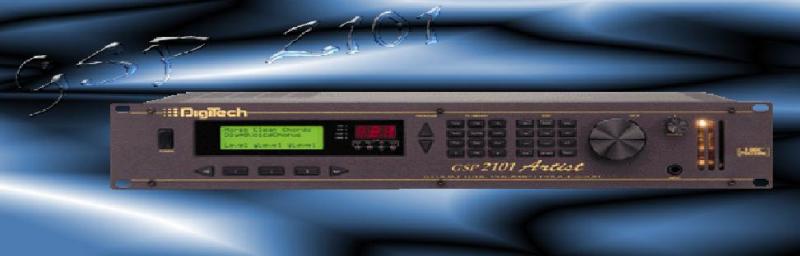
I'll answer the second question first. Yes all of those will
work. The internal signal path of the analog section of the GSP
is:
Input 1 or 2 ->Compression ->Distortion ->EQ ->Noise Gate
-> Master Volume -> Wet Dry Mixer/Dry Send -> FX Send
Which then goes to your triaxis. So not only can you use the Noise
Gate but you can use the compression and distortion also.
One cool thing about this is the noise gate then uses your straight,
clean (provided the GSP distortion is off) guitar signal instead of the
signal after it's been distorted. I find it gives you a much
subtler control of when the gate cuts in and out. From your triaxis
you then go back into the FX return. You didn't say wether you went
into both the left and right returns or just one but I'll address some of
those options next. From there the path is
FX Return -> Analog to Digital Convertor -> Digital Section (i.e.
the algorithms, i.e. the effects) -> Digital to Analog Convertor ->
Wet Dry Mixer/Wet Send -> Wet Dry Mixer (two inputs: one from the Wet
Dry Mixer/Dry Send, one from the Wet Dry Mixer/Wet Send) -> Left &
Right Output
The book isn't clear about the signal path in the analog section but I
figured it out through trial and error. If you'd like to know what
that process was let me know but for now just trust me. The Wet Dry
Mixer basically takes the signal before the Analog to Digital Convertor
and makes that one input and takes the signal after the Digital (effects)
makes that another input and mixes those together. Since with this
setup you want your Wet Dry Mixer to be 100% wet it is not really part of
the equation but thought you'd like to know where it is located in the
chain. And, after all, if you do change your Wet Dry mix to
something else and it sounds good, then it is good, right. The main
reason not to use the dry part is since it's before your Triaxis when you
turn it to dry you won't be mixing it with your dry Triaxis signal at
all. You'll be mixing in your clean pre Triaxis signal. In
order to adjust the Wet Dry ratio in your sound you have to adjust it in
the algorithm itself using the mixers. More hassle but I think
worth it.
Now on to the answer to the first question which is yes. You
then use the master volume to control how hot the signal is that goes to
the Triaxis and use the Triaxis to adjust the signal going back into
the FX return(s). That's a lot of volume knobs between
everything and you have to be a little careful but it's actually not as
bad as it sounds and is worth the trouble. I personally actually
split the FX send with a Y cord and go to two preamp type boxes inputs, a
Sans Amp PSA- 1 and a POD XT. I then send the PSA-1 to the left
return and the POD-XT to the right return. I then create my own
algorithm that has a 2 input mixer at the very beginning so I can now mix
two different "amps" together. I actually mainly use it
to go from a clean to a distorted sound by connecting the volume pedal to
the 2 input mixer levels. Remember the volume pedal (I'm assuming
you mean the foot controller on the Control One pedal board) can be setup
to control ANYTHING. So I have it set on the 2 input mixer to
control both inputs in opposite directions. In other words as I
push the pedal forward one mixer input is turned up (The PSA-1) as it
turns the other mixer input (the POD) down or vice versa. Makes for
a smoother transition between sounds like in the Creed song Higher.
With this set-up you can even create an algorithm that keeps both signals
separate all the way to the outputs.
One warning though. Doing this means you HAVE to create your own
algrothims to at the very least put that two input mixer at the very
beginning. This applies to the factory algorithms. For
example, many of them only use the left input so if I have my POD XT
connected to my right input I'm out of luck. It's not too bad
though. Just stick a 2 input mixer in front of a factory algorithm
and you're set. And again you pretty much HAVE to have the Wet Dry
Mixer at 100% wet.
Even though you only have one distortion (the Triaxis) device you could
actually do something like this by splitting the signal directly after
the guitar with an A/B box (preferably) or just a simple Y cord
adapter. This will give you two distortions. The Triaxis AND
the GSP's distortion. I know the GSP distortion section isn't great
but it's there so why not expand your options and use it. Send your
guitar to both the Triaxis input and to the GSP input. Then send
the Triaxis output to one GSP FX return. You then connect a patch
cord from the FX send directly into the other GSP FX return. You
might think you wouldn't need to connect the patch cord but the GSP won't
use the signal from the FX returns unless the FX send has a plug in
it. You can then mix the GSP distortion with the Triaxis distortion
for a wider variety of sounds or you can keep one clean an make the other
distorted, in each case using that 2 input mixer that you have at the
beginning of your algorithm. If you want to avoid all this just use
the suggestion you liked and everything will work fine. You do need
to go into both the left and right FX returns from your Triaxis though if
you want to take advantage of all the factory algorithms.
Does this make any sense? There are even other ways out there but
I'm running out of time. If you just think of each section as
a "box", you'll see how its just a matter of putting the
boxes in different orders and splitting and combining them in different
ways. I hope I haven't overloaded you. The main point is, the
answer to both your questions is yes but there are many other
possibilities as well. The variety of inputs and outputs combined
with the completely open algorithm creation gives you A LOT of
options. I love this unit and I don't think I'm the only one.
I just wish someone would redo it with all the amp modelling we have
going now and the better A/D/A convertors. That's why I'm setup the
way I am. It doesn't sound perfect but it gives me all the options
I want.
At 10:30 AM 6/22/2003 +0200, you wrote:
Show quoted textHide quoted text
Hi Tod,
your second possibility sounds very good:
Guitar -> GSP In
GSP FX Send -> Triaxis
TriAxis Out -> GSP Return
GSP Out -> Amp
two questions left:
1) the GSP Send goes directely into the MAIN
INPUT of the triaxis?!
2) what about noisegate, volume pedal and
tuner, will they all work?!
thanks already:)
----- Original Message -----
From: Tod Brueske
To:
gsp-2101@yahoogroups.com
Sent: Sunday, June 22, 2003 5:14 AM
Subject: Re: [gsp-2101] Setup for 2101 & TriaAxis using NoiseGate & Tuner
Here's one possibility:
Guitar -> GSP In
GSP FX Send -> Triaxis
Then back to your path
TriAxis FX Send -> GSP Return
GSP Out -> TriAxis Return
TriAxis Out -> Amp
With this you HAVE to make sure that you're wet/dry mixer is always 100% wet and the FX loop is set to No Sum. Anything less than the 100% wet and you will start to hear the GSP analog section with out your Triaxis.
Using it this way you have to adjust the wet dry levels using the mixers in the algorithm but that's the way I always preferred to do it anyway
You could also do it this way:
Guitar -> GSP In
GSP FX Send -> Triaxis
TriAxis Out -> GSP Return
GSP Out -> Amp
Which is the way I generally do it. Still keeping wet/dry at 100% and FX loop set to No Sum.
At 08:28 PM 6/19/2003 +0200, you wrote:
Setup for 2101 & TriaAxis using NoiseGate & Tuner
hello, greetigs from germany;-D
I play a TriAxis and the GSP as a standard setup meaning
Guitar -> TriAxis
TriAxis FX Send -> GSP Return
GSP Out -> TriAxis Return
TriAxis Out -> Amp
, right?!
It works fine!!
The only problem is that the NoiseGate and the tuner won't work that way, same to the Volume Pedal used for Master Volume.
I would "only" need the TriAxis PreAmp and the digital section of the GSP but with the desired Gate, Volume and Tuner functions.
Can anybody help?!
www.michaelborchers.net/sb - personal
www.michaelborchers.net/tri - TriAxis
www.michaelborchers.net/rm - Rockman
www.memoriesfading.de - band
www.cd-pla.net - cd review community
Yahoo! Groups Sponsor
To unsubscribe from this group, send an email to:
gsp-2101-unsubscribe@egroups.com
Your use of Yahoo! Groups is subject to the Yahoo! Terms of Service.
To unsubscribe from this group, send an email to:
gsp-2101-unsubscribe@egroups.com
Your use of Yahoo! Groups is subject to the Yahoo! Terms of Service.
Yahoo! Groups Sponsor
To unsubscribe from this group, send an email to:
gsp-2101-unsubscribe@egroups.com
Your use of Yahoo! Groups is subject to the Yahoo! Terms of Service.