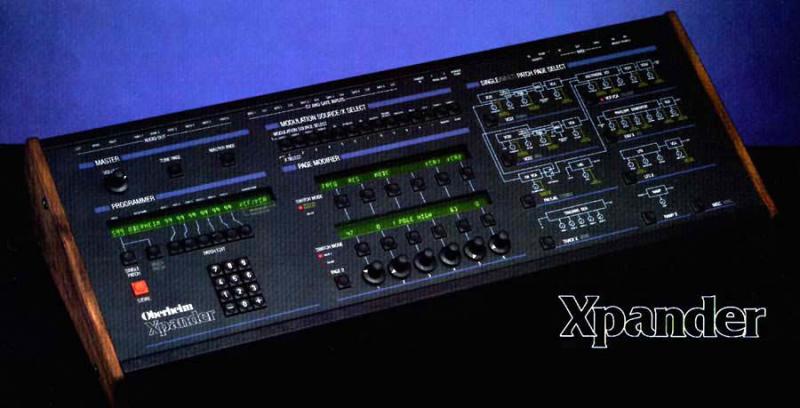
>>There are 2 processors in the Xpandr/Matrix-12.
There are 3 in the Matrix 12, because it has 2 voice boards + the main board.
>>If one of these fails and you need a replacement,- your only chance is to buy a Matrix-1000 used.
I don't remember if the 6809 in the Xpander/Matrix is the 6809 or 6809E (External clock).
These are commercially available and dirt cheap
http://tinyurl.com/4qr3ajv
The Jameco part is an MC68B09EP; the "B" refers to its clock speed (2MHz, where the "A" was 1.5MHz) and the "P" means it's in a plastic package (as Tony mentioned). The original CPU is an MC68B09P. Question is, does the "E" make a difference?
Comparing the pinouts of the two chips from their datasheets, the following pins are labelled differently:
Pin 'EP 'P
33 BUSY DMA/BREQ (where the underline means an inverted signal)
34 E E An input on the 'EP, an output on the 'P.
35 Q Q An input on the 'EP, an output on the 'P.
36 AVMA MRDY
38 LIC EXTAL
39 TSC XTAL
Pin I/O 'EP description
33 BUSY O memory access in progress - used for multiprocessing
34 E I Clock input, TTL level (Q leads E)
35 Q I Clock input, NMOS level
36 AVMA O used for resource sharing in multiprocessor systems
38 LIC O Last Instruction Cycle "indicates opcode fetch"
39 TSC I Three-State Control "controls internal bus buffers"
Pin I/O 'P description
33 DMA/BREQ I "allows DMA operation or memory refresh"
34 E O Clock output (Q leads E)
35 Q O Clock output
36 MRDY I "input extends data access times"
38 EXTAL I External crystal or clock input
39 XTAL I External crystal (or ground)
So as you can see, the "E"; version is a more advanced generation of the original 6809, with pins that were inputs now re-purposed as outputs to allow multiple CPUs to work together, and the clock signals E and Q are now external inputs rather than being generated by the CPU. This means that the 6809E is not going to be backwards-compatible with the 6809 found the Matrix-12 (and the Xpander).
So you'll need to keep looking for the original CPU. Try the Octopart link above, or UTSource (who I've used successfully in the past):
http://utsource.net/HD68B09P.html
OK, looking at the Xpander schematic (since I have an Xpander and not a Matrix-12, although I imagine the latter is very similar) the MRDY and /BREQ inputs are tied high and XTAL is grounded anyway, with the CPU driven from an external clock circuit. So to retrofit a 68B09E, you'd need to cut the traces to pins 33, 36 and 38, then add another clock generator circuit (there's a schematic for one in the 6809E datasheet) and connect it to pins 34 and 35. Then you could power it up and find out whether the firmware still works on the new CPU; it might be best to compare the internal CPU architectures (flag registers etc.) against the code and look for "unused" flag bits, NOP opcodes etc. that now do stuff...
Hitachi makes a pin & instruction compatible replacement for the 6809, which runs up to 4Mhz(I believe).
Imagine what new features the Xpander could have if it would use a faster processor. Sure, a lot of code would need to be re-written, but there are people who like to do that.
To quote
Wikipedia: "
6809 cores are available in VHDL and can be programmed into FPGA and used as an embedded processor with speed ratings up to 40 MHz." So that would be one way to do it, the advantage being that you could have a "legacy mode" that runs the original Xpander firmware on a model of the original CPU. Alternatively, you'd port the firmware to a new CPU and add whatever extra features you wanted. If I ever succeed in cloning myself I'll definitely get one of my replicas to have a go at this.
Disclaimer: I'm not an electrical engineer but I do have a Masters degree in Electrical Engineering, FWIW.
Cheers,
John :^P