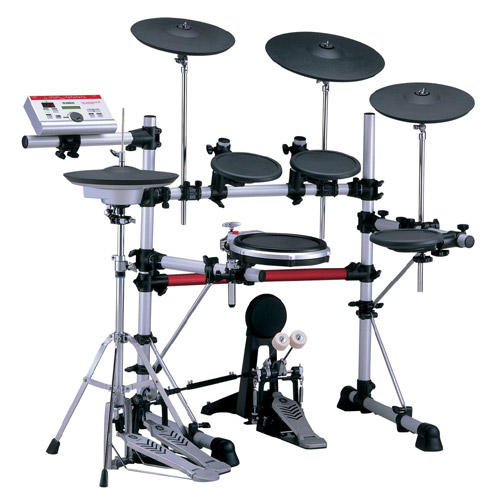
Yamaha DTXpress/DTXplorer/DTXtreme group photo

Yahoo Groups archive

Yamaha DTXpress/DTXplorer/DTXtreme

Index last updated: 2026-04-28 22:44 UTC

Thread

Follow-Up on the TP65S Experiment

Follow-Up on the TP65S Experiment

2004-01-16 by oldguydrummer

Stewart,

This is what I did.

I opened up the TP65S and left the two leads coming from the PCB to 
the pad piezo connected. .

Trial 1: 
--------
I physically isolated the rubber pad containing the piezo from the 
bottom housing with the PCB and the rim switches.

I wacked the rim switches, one at a time. No sound.

I wacked the pad, and the piezo triggered the snare sound.

Trial 2:
--------
I then allowed about 1" of the edge of the rubber pad containing the 
piezo touch the bottom housing. So that when I hit the rim switch, 
the piezo should pick up some of the vibration. 

I wacked the pad, and the piezo triggered the snare sound.

I wacked both the rim switches, no sound.

Trial 3:  
--------
I set the rubber pad almost completely on the housing except for a 
small edge to expose a piece of the rim switch.

I wacked the pad, and the piezo triggered the snare sound.

I wacked the top rim switch, no sound.

Trial 4:
--------
With the rubber pad sitting on the housing, I used my fingers to tap 
the pad and rim.

If I hit the rim slightly before I hit the pad, no sound.

If I hit the pad slightly before I hit the rim, only the piezo 
triggers the snare sound.

If I hit the pad and the rim at exactly the same time (micro-seconds 
here) only the rim triggers, the top one triggers the cross-stick 
and the bottom triggers the rim-shot.

The moral of the experiment.The piezo and the rim switch have to 
triggered within micro-seconds of each other or the rim will not 
trigger the sound assigned to it.

So if you could create a magic box that could transform the piezo 
signal into a rim closer, you would still need a gizmo to 
simultaneously trigger the piezo in the first pad or at least put a 
strong signal on the tip/sleeve, as well as, on the ring/sleeve, so 
that module is tricked into beleive the two inputs (rim/pad) had 
been struck simultaneously. Because without simultaneous triggering 
the rim input won't produce a sound.

The secret maybe in the physical location of the magic box. It may 
have to go between the module and the pads. And it would provide 
the "smarts" for determining whether to just trigger the pad voice 
or the rim voice (or in the case of the inputs 2,6,7 one of the two 
rim voices.)

In other words the magic box has one stereo output jack that goes to 
the module.

It then has one mono jack to pad1, a mono jack to pad2 (and in the 
case of inputs 2,6,7,  one additional mono jack to a third pad.)

If the MB gets a signal from pad1 then it passes the signal directly 
to the module on the tip/sleeve conductor. If the MB gets a signal 
from pad2, it then sends both a "piezo" and a "rim" switch signal 
simultaneously on the tip/ring/sleeve (and in the case of inputs 
2,6,7, a signal from the third pad would send a different signal 
simultaneously on the tip/ring/sleeve cable to the module.)

This all sounds logical to me now, tomorrow I'm sure I look at it 
and go "Huh???"

Any other suggestions, I game to try it.

OGD

Re: Follow-Up on the TP65S Experiment

2004-01-16 by moosetication

--- oldguydrummer wrote:
> (science experiment)
> Any other suggestions, I game to try it.

I just did a much more crude experiment:

Switch tom1 pad type from TP65-2 (mono) to TP65-1 (stereo) so that 
it can handle the rim. It still physically has a TP65-2 attached.

Take the mono cable from the TP65-2, and wire the core (tip) 
connector to BOTH the tip and ring of a stereo plug. Shield goes to 
sleeve as usual.

If I hit the pad HARD, I get the RIM sound on that input! Less hard, 
I get the pad sound. Essentially, the piezo signal must be big 
enough when you really whack it that it looks like a switch closure.

Basically, this is "Shack Adapting" as used by Roland drivers who 
don't have layering on their modules.

Now all one needs to do this properly is a magic box to ensure the 
rim simulation doesn't need the pad to be struck with a lump hammer, 
and we're done! 

I'm going to send you a picture, because my prose isn't up to this!

Stewart

Re: Follow-Up on the TP65S Experiment

2004-01-16 by oldguydrummer

> 
> Any other suggestions, I game to try it.
> 
> OGD

One more thing, you would think that Yamaha would realized that 
someone would come along that would what to take thier stuff apart, 
again and again and again. They could have made it a little easier 
to remove that rubber pad covering and easier to disconnect and 
reconnected all those thing-a-mabob inside.


;)

OGD

Re: Follow-Up on the TP65S Experiment

2004-04-27 by Keith

--- In DTXpress@yahoogroups.com, "oldguydrummer" <rdamon@m...> wrote:
> Stewart,
> 
> This is what I did.
> 
> I opened up the TP65S and left the two leads coming from the PCB to 
> the pad piezo connected. .
> 
> Trial 1: 
> --------  <<< CUT >>>

I am planning to design and build the "magic box"  but I seem to
remember a post around the same time as this one that gave the maximum
time between the rinm switch closing and the piezo triggering (or vice
versa) to get the required sound from the rim.  I have searched the
archives but cannot find it again.  Does anyone know the answer.  It
is important because if the rim switch needs to be closed before the
piezo triggers I will need to add a small delay in the "rim" piezo
signal because I will not be able to close the rim switch signal
before the piezo has been hit.

Keith.

Re: Follow-Up on the TP65S Experiment

2004-04-27 by emf

--- In DTXpress@yahoogroups.com, "Keith" <keith@k...> wrote:
> I am planning to design and build the "magic box"  but I seem to
> remember a post around the same time as this one that gave the 
maximum
> time between the rinm switch closing and the piezo triggering (or 
vice
> versa) to get the required sound from the rim.  I have searched the
> archives but cannot find it again.  Does anyone know the answer.  It
> is important because if the rim switch needs to be closed before the
> piezo triggers I will need to add a small delay in the "rim" piezo
> signal because I will not be able to close the rim switch signal
> before the piezo has been hit.

Within the limits of possible measurements on our scale, the two 
events are simultaneous, or as OGD put it, "The piezo and the rim 
switch have to be triggered within micro-seconds of each other or the 
rim will not trigger the sound assigned to it." OGD's experiment 
permitted no perceptible lag time.

Ed

Re: Follow-Up on the TP65S Experiment

2004-04-27 by Keith

--- In DTXpress@yahoogroups.com, "emf" <liberatusvirus@y...> wrote:
> --- In DTXpress@yahoogroups.com, "Keith" <keith@k...> wrote:
> > I am planning to design and build the "magic box"  but I seem to
> > remember a post around the same time as this one that gave the 
> maximum
> > time between the rinm switch closing and the piezo triggering (or 
> vice
> > versa) to get the required sound from the rim.  I have searched the
> > archives but cannot find it again.  Does anyone know the answer.  It
> > is important because if the rim switch needs to be closed before the
> > piezo triggers I will need to add a small delay in the "rim" piezo
> > signal because I will not be able to close the rim switch signal
> > before the piezo has been hit.
> 
> Within the limits of possible measurements on our scale, the two 
> events are simultaneous, or as OGD put it, "The piezo and the rim 
> switch have to be triggered within micro-seconds of each other or the 
> rim will not trigger the sound assigned to it." OGD's experiment 
> permitted no perceptible lag time.
> 
> Ed

Thanks, I thought someone had actually measured it, but it may have
just been a subjective "microseconds" I remember.  I will have to
experiment or get the oscilloscope and signal generator moved into the
drum room and measure it.  I suspect I will need to close the switch
just before the piezo which means I will need to delay the piezo
signal slightly from the pad being used as a rim input.  One strange
thing I noticed is that if you hold the rim switch closed it ignores it!

Keith.

Re: Follow-Up on the TP65S Experiment

2004-04-27 by emf

--- In DTXpress@yahoogroups.com, "Keith" <keith@k...> wrote:
> Thanks, I thought someone had actually measured it, but it may have
> just been a subjective "microseconds" I remember.  I will have to
> experiment or get the oscilloscope and signal generator moved into 
the
> drum room and measure it.  I suspect I will need to close the switch
> just before the piezo which means I will need to delay the piezo
> signal slightly from the pad being used as a rim input.  One strange
> thing I noticed is that if you hold the rim switch closed it 
ignores it!

Keep us informed. You will become a very popular guy (not to say that 
you aren't now) if you succeed. 

Ed

Re: Follow-Up on the TP65S Experiment

2004-04-27 by Keith

--- In DTXpress@yahoogroups.com, "emf" <liberatusvirus@y...> wrote:
> --- In DTXpress@yahoogroups.com, "Keith" <keith@k...> wrote:
> > Thanks, I thought someone had actually measured it, but it may have
> > just been a subjective "microseconds" I remember.  I will have to
> > experiment or get the oscilloscope and signal generator moved into 
> the
> > drum room and measure it.  I suspect I will need to close the switch
> > just before the piezo which means I will need to delay the piezo
> > signal slightly from the pad being used as a rim input.  One strange
> > thing I noticed is that if you hold the rim switch closed it 
> ignores it!
> 
> Keep us informed. You will become a very popular guy (not to say that 
> you aren't now) if you succeed. 
> 
> Ed

If anyone is interested (probably only me), the rim switch closes
around 1ms before the piezo wakes up, and the rim switch can pretty
much have returned to the normal postion by the time the piezo signal
is a significant size depending on how hard you hit it.  Either way, I
will need a delay on the rim piezo of around 2ms so I can switch the
rim before the piezo signal.  The piezo signal rings for around 30ms
at around 250Hz after being hit.  If anyone wants to see I can put the
waveforms in the file section.

I can see that a little box would be a good idea - there seem to be a
lot of unused "stereo" inputs which would allow the addition of extra
pads without a new DTXpress box.  Even the kick drum has a rim pad!

Must do some work now, will try to do the design later this week.

Keith.

Re: Follow-Up on the TP65S Experiment

2004-04-27 by emf

--- In DTXpress@yahoogroups.com, "Keith" <keith@k...> wrote:
> If anyone is interested (probably only me), the rim switch closes
> around 1ms before the piezo wakes up, and the rim switch can pretty
> much have returned to the normal postion by the time the piezo 
signal
> is a significant size depending on how hard you hit it.  Either 
way, I
> will need a delay on the rim piezo of around 2ms so I can switch the
> rim before the piezo signal.  The piezo signal rings for around 30ms
> at around 250Hz after being hit.  If anyone wants to see I can put 
the
> waveforms in the file section.
> 
> I can see that a little box would be a good idea - there seem to be 
a
> lot of unused "stereo" inputs which would allow the addition of 
extra
> pads without a new DTXpress box.  Even the kick drum has a rim pad!
> 
> Must do some work now, will try to do the design later this week.

Keith,

Please do put all info that you see fit in the Files section. 

Ed

Move to quarantaine

This moves the raw source file on disk only. The archive index is not changed automatically, so you still need to run a manual refresh afterward.