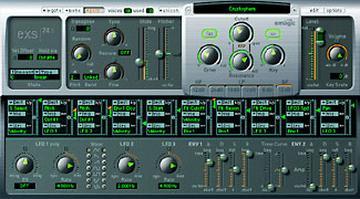
EXS 24 Logic Sampler Users Group group photo

Yahoo Groups archive

EXS 24 Logic Sampler Users Group

Index last updated: 2026-04-28 23:25 UTC

Thread

long notes

long notes

2005-12-03 by gcala5

Hi!
Im' using cello (bowed) in a piece and I need some long notes. It happens that they are 
(shortly) too long and the sample loops from it's beginning during the last (few) milliseconds, 
so I hear the attack twice. In the "real word" if you play very piano the bow is long enough to 
allow this (the part will be played by a real player), but now the music has to be listened by 
my client, before it will "really" played. Which parameters should I use (eg, temporaly, like 
midi messages, or anything else) to allow long notes?
Thanks in advance

Gianfrancesco

Re: [EXS] long notes

2005-12-03 by Eli Krantzberg

On Dec ,3, 2005, at 9:13 AM, gcala5 wrote:

> Im' using cello (bowed) in a piece and I need some long notes. It 
> happens that they are
> (shortly) too long and the sample loops from it's beginning during the 
> last (few) milliseconds,
> so I hear the attack twice. In the "real word" if you play very piano 
> the bow is long enough to
> allow this (the part will be played by a real player), but now the 
> music has to be listened by
> my client, before it will "really" played. Which parameters should I 
> use (eg, temporaly, like
> midi messages, or anything else) to allow long notes?

You could try opening the sample in the sample edit window and 
adjusting the loop points so that it doesn't go right back to the 
beginning when it loops. You'll see little triangular "L" markers in 
the sample edit window to do this. They look a bit like the start and 
end markers, but are meant just for setting loop in and out points.


--------
Eli Krantzberg
http://www.nightshiftorchestra.com
Almat Productions

Re: [EXS] long notes

2005-12-04 by Sascha Franck

Eli Krantzberg wrote:
> You could try opening the sample in the sample edit window and
> adjusting the loop points so that it doesn't go right back to the
> beginning when it loops. You'll see little triangular "L" markers in
> the sample edit window to do this. They look a bit like the start and
> end markers, but are meant just for setting loop in and out points.

Yeah. In addition, usually a bit of crossfading will be required to get smoother transitions from loop end to loop start.
Experiement with different values and carfully listen to possible phasing problems during the x-fade.
In general, longer loops will sound better, but if the sound changes much over time, they might sound unnatural. Finding and
adjusting proper loop points on strings is a timeconsuming task...

Regards,
Sascha

Re: long notes

2005-12-05 by gcala5

> Eli Krantzberg wrote:
> > You could try opening the sample in the sample edit window and
> > adjusting the loop points so that it doesn't go right back to the
> > beginning when it loops. You'll see little triangular "L" markers in
> > the sample edit window to do this. They look a bit like the start and
> > end markers, but are meant just for setting loop in and out points.

 "Sascha Franck" <S.Franck@g...> wrote:
> 
> Yeah. In addition, usually a bit of crossfading will be required to get smoother 
transitions from loop end to loop start.
> Experiement with different values and carfully listen to possible phasing problems 
during the x-fade.
> In general, longer loops will sound better, but if the sound changes much over time, 
they might sound unnatural. Finding and
> adjusting proper loop points on strings is a timeconsuming task...
> 
> Regards,
> Sascha
>

Many thanks for your answers. Have tried Eli's suggestments and missed exactly the later 
Sacha's answer about crossfading (to avoid the 'bump' between loop start and end), but 
since my inexperience in logic's sample editor (I used Peak in the past on OS9) I am a bit 
confused with saving my editings and other tasks:
1) How can I put a cross-fade between loop end and beginning? They are far away.
2) It's all the time a destructive editing, isn't it?
3) There are 3 types of cello attack modes mf, marcato and another, but they seem to 
responde at all at the same velocity values (0-127). How do I know what sample logic 
chooses when I play the part?
I'm shure that it's a reklativly simple task, but please help me to save a little time.
TIA
Gianfrancesco

Re: [EXS] Re: long notes

2005-12-05 by Eli Krantzberg

On Dec ,5, 2005, at 3:56 AM, gcala5 wrote:


> 1) How can I put a cross-fade between loop end and beginning? They are 
> far away.

In the EXS edit window, right next to the "E" button you press to open 
the sample in the sample edit window, there is a box where you can 
enter a cross-fade values. It's all numeric, there is no visual 
representation of the cross-fade you are creating. You have to set it 
by trial and error using your ears and the numbers.


> 2) It's all the time a destructive editing, isn't it?

No. The exact opposite. Altering loop points and setting cross-fade 
values is completely non destructive.


> 3) There are 3 types of cello attack modes mf, marcato and another, 
> but they seem to
> responde at all at the same velocity values (0-127). How do I know 
> what sample logic
> chooses when I play the part?

Look at the "view" settings in the EXS edit window for that instrument. 
There are different view modes that allow the selected zones to be 
displayed underneath the keyboard icon and for them to jump to the top 
of the zone and/or group list.


--------
Eli Krantzberg
http://www.nightshiftorchestra.com
Almat Productions

Move to quarantaine

This moves the raw source file on disk only. The archive index is not changed automatically, so you still need to run a manual refresh afterward.