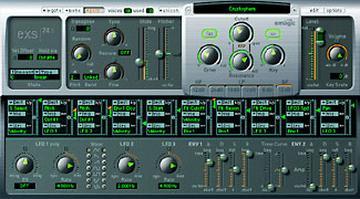
EXS 24 Logic Sampler Users Group group photo

Yahoo Groups archive

EXS 24 Logic Sampler Users Group

Index last updated: 2026-04-28 23:25 UTC

Thread

Re: [exs] Polyphony and CPU

Re: [exs] Polyphony and CPU

2001-11-22 by yael

----- Original Message -----
Show quoted textHide quoted text
From: Dave Howard
To: EXS User Group
Sent: Thursday, November 22, 2001 4:07 PM
Subject: [exs] Polyphony and CPU


Hello!

Can anyone answer this:
Apparently multiple instance of the EXS don't use any more CPU than
one....correct?

> If there is no FILTER ON....

Am I correct in assuming that the polyphony of the instances DOES affect CPU
usage?

> When nothing play, correct....

And is it dynamic? In other word, 16 instances with maximum polyphony won't
increase CPU load, but as the number of notes/voices being used increases so
does the CPU load.....?

> Yes the Polyphony is dynamic, u can open 24 EXS with full Poly if nothing
is played and if there is no Filters enable

Is there any benefit to limiting polyphony in the instances of the EXS?
Dave

> Well, good question ;o)
> It's good because it works like a Priority system... If there is too many
Poly on every Instrument and too >many "RELEASE" on every EXS u gonna
FREEZZE everytime ! but if u limit the Poly on each EXS it's >better...
Igor

Re: [exs] Polyphony and CPU

2001-11-22 by Sascha Franck

Dave Howard wrote:
> Can anyone answer this:
>
> Apparently multiple instance of the EXS don't use any more CPU than
> one....correct?

As long as they are a) not playing anything and b) their tracks are not
selected in your arrange, yes.
As soon as you select a virtual instrument track in the arrange (no matter
if there are sequences or not) it will start using a bit of CPU as it has to
be "realtime-enabled".

> Am I correct in assuming that the polyphony of the instances DOES affect
CPU
> usage?

I didn't noticee any difference on my machine, playing the same sequence
(like 3 note chords without any overlapping notes and/or release times)
through an 8 voice patch and through the same patch with the voices raised
to 64.

> And is it dynamic? In other word, 16 instances with maximum polyphony
won't
> increase CPU load, but as the number of notes/voices being used increases
so
> does the CPU load.....?

I don't quite understand this question...
More voices being played = more CPU load. As said above as long as there's
not as much voices being played as the polyphony setting allows I can't
notice amy difference (well, maybe I should check that back under real high
CPU load).

> Is there any benefit to limiting polyphony in the instances of the EXS?

Yes. Here's an example: Let's assume you have a pad sound with a fairly long
release time. Now play some chords changing faster than your release time
(maybe you could even play 3 or 4 chords before the release is "finished").
Let's now assume you're playing 4 part voicing with 2 zones per each voice =
8 voices in total. Now play the second voicing before the first chord is
completely released = 16 voices. 3rd chord = 24 voices.
This will eventually result in pretty much voices being used = high CPU
load.
But of course it might not be necessary to have all the releasing voices
being still present on the 3rd chord (maybe not even on the second), so you
could just limit your polyphony to 16 voices (or maybe even to 8). This
would make sure that at the time you play your 3rd chord everything
"redundant" from the 1st chord will be "stolen".
Especially when dealing with patches only using a small amount of "vertical"
zones (in that case the EXS has to do a lot of pitch calculation which still
seems to be one of the most CPU hungry things) this method could save up
quite some CPU horsepower.

Regards,
Sascha

Re: [exs] Polyphony and CPU-sacha

2001-11-22 by ythan@btinternet.com

sacha wrote:

> Especially when dealing with patches only using a small 
amount of "vertical"
> zones (in that case the EXS has to do a lot of pitch calculation 
which still
> seems to be one of the most CPU hungry things) this method 
could save up
> quite some CPU horsepower.
----

hi sacha,
 im not following what you're saying here, could you elaborate, 
please?

Re: [exs] Polyphony and CPU

2001-11-22 by Eppo Schaap

> Apparently multiple instance of the EXS don't use any more CPU than
> one....correct?

When a virtual instrument is routed to a second plugin or bus it always uses
CPU, also when there are no notes played (back). So several EXS24 routed to
the same bus won't cause much more CPU but they do when every EXS has an
individual plug in in it's slot added.

Eppo Schaap
Galbatron Symphonic Electronica
website: www.galbatron.com
music: www.ampcast.com/galbatron

Re: [exs] Polyphony and CPU-sacha

2001-11-22 by Sascha Franck

I wrote:
> > Especially when dealing with patches only using a small
> amount of "vertical"
> > zones (in that case the EXS has to do a lot of pitch calculation
> which still
> > seems to be one of the most CPU hungry things) this method
> could save up
> > quite some CPU horsepower.
> ----

ythan@... replied:
>  im not following what you're saying here, could you elaborate,
> please?

Sure.
Create a patch using only one zone throughout your keyrange with a rather
low key note (like C1 or C0). Copy that zone multiple times (otherwise on a
powerful computer you won't be able to notify the difference in CPU load,
there's got to be many voices playing).
Now play let's say a 4-part voicing close to the key note. Then play the
same voicing let's say 5 or 6 octaves above. Watch your CPU meter while
doing so, it will defenitely go up as soon as you play voicings being far
away from the key note. This is because the EXS apparently needs quite some
CPU power to pitch samples.
Also a good reason to use more than one sample all through your keyrange (in
case it's possible).

Regards,
Sascha

Re: [exs] Polyphony and CPU-sacha

2001-11-22 by Dave Howard

Ok, can we summarise as simply as possible for dimwits like me!.....

Correct me if I'm wrong -

1.
Inactive multiple Instances of EXS don't take up any more CPU *unless* the
filter is active....?

2.
Polyphony settings in themselves don't take up extra CPU, but..........

3.
The number of voices actually playing does affect CPU load, hence -

4.
Number of zones that are activated at one time takes up extra CPU,......but
creating one big zone for a sample isn't necessarily going to use less
because transposing the sample takes up CPU....

yes? no?

:-/

Dave

on 22/11/01 11:48 PM, Sascha Franck at saschafranck@... wrote:

> Sure.
> Create a patch using only one zone throughout your keyrange with a rather
> low key note (like C1 or C0). Copy that zone multiple times (otherwise on a
> powerful computer you won't be able to notify the difference in CPU load,
> there's got to be many voices playing).
> Now play let's say a 4-part voicing close to the key note. Then play the
> same voicing let's say 5 or 6 octaves above. Watch your CPU meter while
> doing so, it will defenitely go up as soon as you play voicings being far
> away from the key note. This is because the EXS apparently needs quite some
> CPU power to pitch samples.
> Also a good reason to use more than one sample all through your keyrange (in
> case it's possible).
> 
> Regards,
> Sascha
> 

-- 
Web Design, Music Composition and Production, Music Technology Training and
MORE!
www.chadales.co.uk

Re: [exs] Polyphony and CPU-sacha

2001-11-23 by Eppo Schaap

> 1.
> Inactive multiple Instances of EXS don't take up any more CPU *unless* the
> filter is active....?

...and *unless* there are extra sound processing plugs in the signal path
after the EXS.

Eppo Schaap
Galbatron Symphonic Electronica
website: www.galbatron.com
music: www.ampcast.com/galbatron

Move to quarantaine

This moves the raw source file on disk only. The archive index is not changed automatically, so you still need to run a manual refresh afterward.